Call us: +91 8883310222, +91 8973998399
Coimbatore
🇺🇸 English
We’re here to answer any question you may have.
+91 8883310222, +91 8973998399
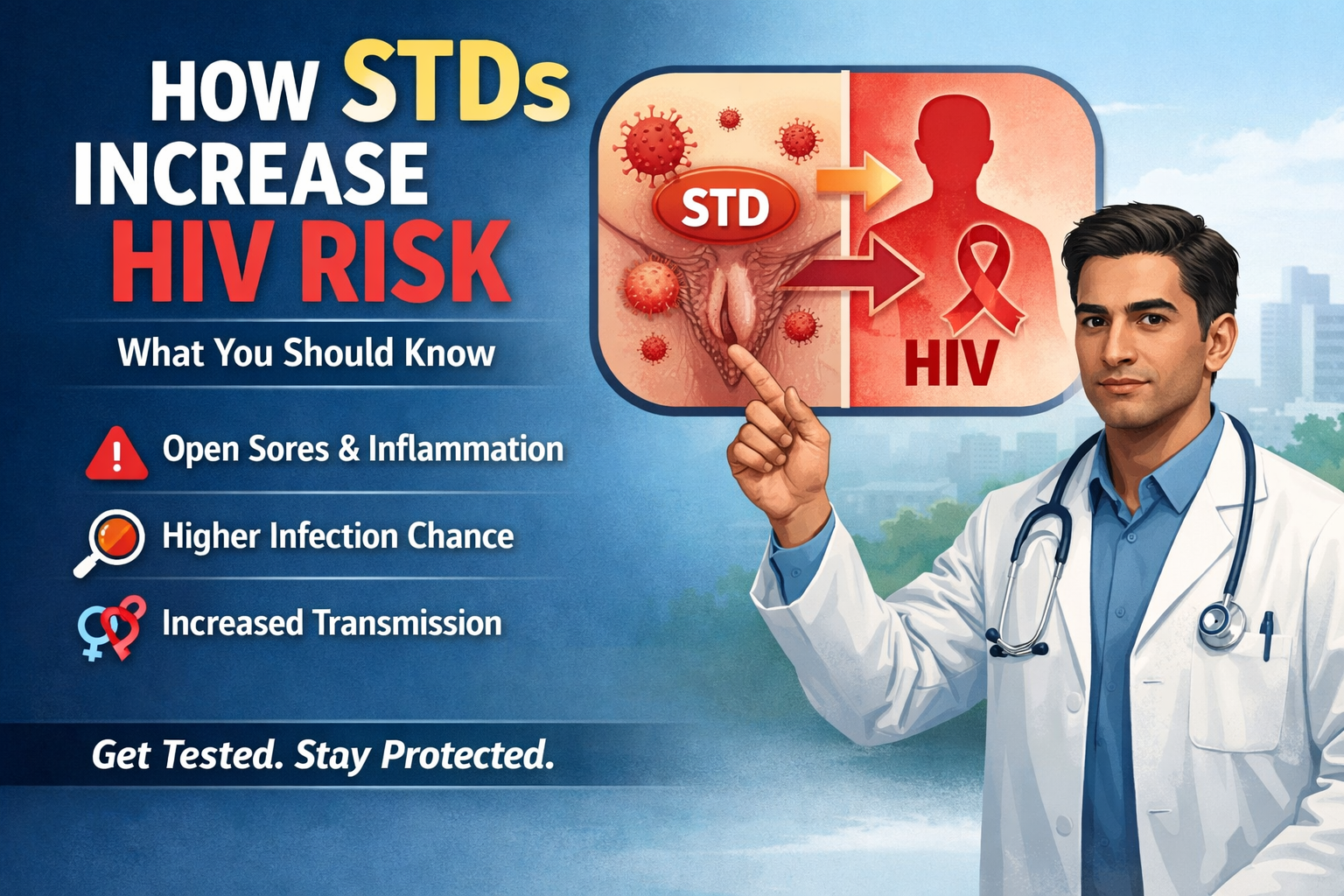
How STDs increase HIV risk is one of the most important yet misunderstood topics in sexual health. Many people believe HIV and other sexually transmitted diseases (STDs) are separate conditions. However, having an STD significantly increases the chances of contracting HIV.
Understanding this connection is essential for prevention, early diagnosis, and long-term health protection.
STDs and HIV are closely connected because both are transmitted through:
When a person has an STD, especially untreated infections, the body becomes more vulnerable to HIV infection.
This is why doctors strongly emphasize early diagnosis and treatment.
Some STDs such as syphilis and herpes cause:
These openings allow HIV to enter the bloodstream easily during exposure.
Infections like gonorrhea and chlamydia cause inflammation in the genital area.
This leads to:
If a person already has HIV and another STD:
This means STDs not only increase HIV acquisition but also transmission.
The following infections are known to increase HIV risk significantly:
Each of these infections weakens natural protective barriers in the body.
Understanding symptoms helps reduce risk.
Watch for:
Yes.
HIV can remain silent in early stages. Some individuals may experience mild flu-like symptoms, while others notice nothing.
This is why testing is essential even if you feel healthy.
Testing is recommended if:
Condom use significantly reduces risk.
Routine screening helps detect infections early.
Early treatment reduces HIV vulnerability.
Avoid multiple or unknown partners.
Early diagnosis and treatment of STDs:
According to the World Health Organization (WHO), untreated STDs significantly increase the risk of acquiring HIV due to biological changes in the body.
https://www.who.int/news-room/fact-sheets/detail/sexually-transmitted-infections-(stis)
Many people underestimate the connection between STDs and HIV. Lack of awareness leads to:
Education and early action are the best protection.
Understanding how STDs increase HIV risk helps you make informed health decisions.
Partner awareness plays a crucial role in reducing the spread of both STDs and HIV. Many infections spread unknowingly because one partner may not show symptoms. Open communication and mutual testing can significantly lower transmission risks.
Couples are encouraged to undergo testing together, especially before entering long-term relationships or marriage. This approach helps in early detection and ensures that both partners receive appropriate medical care if required.
Regular follow-up testing is also important, as some infections may not be detectable immediately after exposure. Early screening combined with responsible behavior is the most effective way to control infection spread.
For more medical insights on infection and immunity, refer to the National Institutes of Health (NIH):
https://www.niaid.nih.gov/diseases-conditions/hiv-infection
The connection between STDs and HIV is real and medically proven. Ignoring STD symptoms or delaying treatment can significantly increase your risk of HIV infection.
Early awareness, regular testing, and safe practices are essential for maintaining long-term sexual health.
KK Diabetes & Sex Care Centre
35/1B, Kanuvai to Thudiyalur Road, VKL Nagar, Thudiyalur, Tamil Nadu – 641029
+91 88833 10222 | +91 89739 98399
Book your confidential appointment today and protect your long-term health.
Adding {{itemName}} to cart
Added {{itemName}} to cart